
Love Your Smile
#1 Dental Implants Chicagoland IL & LaSalle County IL
Expert Permanent Tooth Replacement
Table of Contents
Missing or failing teeth can affect much more than your appearance. They can make it harder to eat comfortably or speak clearly, and can change the way you feel about your smile–and yourself.
The good news is that dental implants can help you restore both the function and appearance of your smile, with long-term stability.
At Allstar Implants Plus, your dental implants care is personally planned and performed by a genuine expert — Dr. Sam Simos, who as a:
- nationally recognized clinician
- published author
- post-graduate educator
has been teaching other dentists for 20+ years. About the same advanced implant, cosmetic, and restorative techniques he uses daily for his own patients.
That’s why people from Chicagoland, IL and local areas throughout LaSalle County and Grundy County in Illinois communities choose Dr. Sam Simos for real expert implant treatment, that’s individually custom-designed for:
- optimal function
- natural-looking results
- long-term success
Now that’s a real difference, that really matters.
Can dental implants replace missing teeth?
Yes. Dental implants are the most advanced solution for replacing missing or failing teeth–and can even replace existing dentures that don’t stay in place, make eating difficult, and cause daily frustration.
Dental implants can replace a single missing tooth, an area of several missing teeth, and a full arch or full mouth of missing teeth. With dental implants, you can:
- regain function, getting back to eating and chewing foods you love
- restore the appearance of your smile–no more hiding or holding back
- preserve your bone levels, by stimulating the jaw bone much like your natural teeth roots
- provide facial support, avoiding a ‘sunken-in’ look that makes you look older than you are.
A few thanks from our VIP's like you in Chicagoland, IL & LaSalle County, Illinois

What are dental implants?
Dental implants are a secure, long-lasting solution for missing teeth, consisting of small, screw-like posts that function as artificial tooth roots.
Made of titanium–a biocompatible material that our bodies won’t reject–implants are surgically placed into the jawbone where they integrate and bond with the bone (via a process known as osseointegration), creating a stable and secure foundation for replacement teeth.
Once healed, implants can support a variety of restorations, including:
- single replacement tooth, or crown
- implant bridge
- implant-supported dentures (removable)
- full arch replacement teeth (fixed)
Because dental implants fuse with the jawbone, they help preserve bone structure and provide stability that traditional bridges and dentures cannot match.
For many, dental implants provide the closest possible replacement to natural teeth. Allowing you to confidently eat and chew the foods you love, without missing out.
Are implant teeth fixed or removable?
When you’re considering implants for a full arch of replacement teeth or full-mouth implants, it helps to think in terms of the type of attachment–referred to as an abutment– that’s used with the dental implants. The abutment is what determines whether your replacement teeth are fixed or removable.
The implant abutment is the part that connects the replacement teeth to the dental implants that are surgically placed in your jawbone.
There are two (2) types of dental implant abutments:
- screw-in
- snap-in
Abutments with a ‘screw-in’ design allow for the replacement teeth to be fixed in place. These types of abutments are commonly used for:
- single tooth implant + crown
- implant bridge for areas of multiple missing teeth
- full arch of permanent replacement teeth, that you can’t independently remove.
Abutments with a ‘snap-in’ design allow for a full arch of replacement teeth– often referred to as an ‘overdenture‘– to be:
- securely attached to the dental implants in your jawbone, eliminating the need for sticky adhesives
- independently removeable at home for preventative care, and then snapped securely back into place.
The type of full arch dental implants and abutments that are chosen typically depend on the area of missing teeth, your lifestyle and your budget.
Implants
Results You'll Love
From A - Z
from Patients in IL
2nd+ Opinion

Why does experience matter in dental implant treatment?
Dental implant treatments require precise surgical placement and restorative design and execution.
Highly experienced clinical professionals:
- are better equipped to handle anatomical challenges
- accurately evaluate & plan treatment
- safely perform surgery
- complete natural-looking, properly fitted final restorations.
The surgical placement of implants and their restoration represents a series of impactful decisions that affect your:
- jawbone health
- bite alignment
- smile aesthetics
- long-term results
Dental implants involve permanent decisions, which is why choosing a highly experienced implant and restorative doctor helps protect you– and your investment.
Is implant dentistry considered a dental specialty?
No, it is not. Implant dentistry, also referred to as ‘dental implantology’, is not recognized as a formal specialty by the American Dental Association (ADA), meaning dentists must pursue extensive training beyond dental school to develop expertise.
Any dentist can market themselves as a ‘dental implant specialist’. Because of this, it’s all the more critical that you carefully look at the qualifications of the dentist you choose for dental implant procedures.
What's important when choosing a dentist for dental implants?
When evaluating dental implant providers, it is important to consider whether the dentist has:
- comprehensive post-graduate education in advanced implant dentistry
- extensive hands-on surgical experience with dental implants and bone grafting
- expertise in 3D implant diagnostics and planning
- expertise in complex cases and bone loss
Along with the surgical placement of implants in your jawbone, dental implant procedures typically represent a significant financial investment.
So it’s worth it that you take the time to find out detailed information about the post-graduate education and experience level of the dentist you’re considering.
Choosing an experienced implant provider can help ensure:
- long-term success
- reduce the risk of complications
- protect your investment
Why choose Dr. Sam Simos for your dental implants?
When it comes to restoring your smile with dental implants, proven experience and execution matter.
At Allstar Implants Plus, every dental implant treatment is personally planned and executed by Dr. Sam Simos, who has for more than two decades:
- taught advanced clinical techniques to other dentists, including complex full arch & full mouth rehabilitation
- shared his clinical expertise with global dental manufacturers in development and evaluation of materials & digital technologies
Whether your needs are simple or complex, Dr. Sam Simos brings this same level of comprehensive knowledge and expertise to the planning and execution of your implant and restorative treatment.
How does implant dentistry expertise benefit patients?
Working with an implant and restorative expert like Dr. Sam Simos, provides you with enhanced precision, safety, and long-term success.
Specialized expertise allows for:
- advanced diagnostics and customized planning
- accurate assessment of bone density
- 3D custom-printed surgical guides, for precise implant placement
- comprehensive care–from bone grafting, to implant surgery, to final prosthetic restorations
Choosing a trusted, nationally recognized authority like Dr. Sam Simos, reduces risk and complications, and improves long-term outcomes.
Doesn’t your smile deserve the protection of a recognized and trusted expert?
What dental implants solutions are available to replace missing teeth?
Whether you are missing a single tooth, several teeth, or an entire arch, dental implants provide a long-lasting way to restore comfort, function, and confidence. At Allstar Implants Plus, Dr. Sam Simos expertly designs dental implant solutions to match your specific needs.
Dental implant solutions to replace missing teeth include the following:

Fixed Full Arch Dental Implants
Best for: People missing many or all teeth per arch, wanting a permanent option to removable dentures, with maximum stability.
Restore an entire arch of teeth with a permanent solution that looks and functions just like natural teeth.
Key benefits + design:
- Securely fixed in place. No slipping + no daily adhesives needed.
- Designed for long-term stability and everyday comfort.
- Four screw-in implants secure zirconia teeth
- Allstar Lifetime Smile Warranty™

Implant Dentures (Snap-in)
Best for: People looking for a secure upgrade to removable dentures, with option for at-home cleaning.
Secure alternative to loose or uncomfortable dentures that gives you security you want for eating & smiling.
Key benefits + design:
- Snap securely into place without messy adhesives.
- Easy to remove for independent cleaning at home.
- All on X (4+ implants) provide stability + bone retention
- More affordable price point for full arch teeth vs. screw-in

Implant-Supported Bridges
Best for: People missing multiple teeth in an area, seeking fixed replacement teeth.
Close larger gaps with a stable, long-lasting fixed solution without need for crowns on adjacent teeth.
Key benefits + design:
- Replaces multiple missing teeth with strong, custom-fitted bridges.
- Offers a secure, natural feel tailored to your smile, while preserving your bone.
- Use 2 or more implants, depending on space to be spanned

Single Tooth Dental Implants
Best for: People looking to replace one missing tooth with a fixed option that preserves nearby bone.
Replace a single missing tooth with a natural-looking, permanent solution that blends into your smile.
Key benefits + design:
- Restores one tooth without affecting healthy neighboring teeth.
- Provides strength, durability, bone retention, and a natural appearance.
- Provides strength, durability, bone retention, and a natural appearance.

Teeth-in-a-Day Dental Implants
Best for: People looking for a full arch of replacement teeth that are fixed in place the day of dental implant surgery.
“Teeth in a day” describes an implant treatment approach in which dental implants are placed and a temporary set of replacement teeth is delivered in the same appointment. For many patients, this means leaving surgery with a complete smile already in place.
This approach is often associated with the All-on-4™ treatment, a protocol developed to support immediate full-arch temporary teeth while the implants heal and integrate with the jawbone.
After a healing period of several months, the full arch of temporary teeth are replaced with the final custom permanent teeth.
Key benefits:
- Leave with temporary teeth the same day in many cases
- Fixed full-arch solution during healing
- Improved confidence and appearance immediately after surgery
- Final full arch prosthetic placed after healing is complete
Typical treatment design:
- Strategically placed implants
- Temporary screw-retained full-arch teeth
- Final prosthesis after 3–4+ months of healing
Considering ‘teeth-in-a-day’? With a proven dental implant and prosthetics expert like Sam S. Simos DDS PC at your side, a lifetime of confidence can be yours.
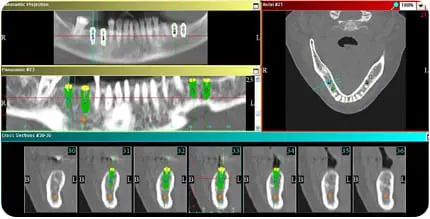
What technology is used in planning & placement of dental implants?
As part of a comprehensive evaluation in planning dental implants, advanced dental imaging and digital technologies are utilized to ensure accurate evaluation of jaw bone quality and identification of optimal implant placement sites.
These technologies include:
- 3D CBCT imaging
- digital scans
- digital or virtual implant planning
- 3D printing
- custom surgical guides
In combination, the use of these advanced technologies by an experienced surgical and restorative implant clinician help ensure precise dental implant placement, for predictable and successful treatment results.
What is 3D CBCT imaging, and why it's needed for dental implants?
A 3-dimensional cone beam computed tomography– or 3D CBCT– imaging is the only way to see the cross-sectional and three-dimensional view of your jawbone and any existing teeth.
While a typical digital x-ray may provide some initial clues about your bone, only a 3D CBCT provides for essential measurements of:
- bone height & width
- bone density
- whether bone grafting may be needed
- proximity to anatomical structures (such as nerve & sinus areas)
- whether immediate implant placement is appropriate
It’s only with the 3D CBCT imaging that a full and accurate assessment can be made by an experienced implant clinician, in preparation for the surgical placement of dental implants.

Why is Zirconia used for fixed full arch implants?
Zirconia is a ceramic, biocompatible material that’s used for full-arch fixed implants due to its superior strength, durability, and natural appearance.
Key attributes of zirconia for full-arch fixed restorations include:
- natural aesthetics, with custom shading
- highly resistant to bite forces and wear
- stain & odor resistant
Zirconia fixed full-arch teeth can be an exceptionally natural-looking, permanent alternative to removable dentures.
Why choose Dr. Sam Simos for zirconia fixed full-arch teeth?
Your new smile isn’t just crafted to last. It’s clinically engineered for life by Dr. Sam Simos, a nationally recognized post-graduate educator and published expert in cosmetic, implant and restorative dentistry.
At Allstar Implants Plus, every fixed full arch zirconia restoration is:
- digitally designed
- precisely placed
- custom-finished
for natural function and aesthetics. By an expert. For a lifetime.
That’s why we confidently back each one with the Allstar Lifetime Smile Warranty™ — coverage that reflects both the strength of our materials and the precision of our expert execution.
If your zirconia full arch smile ever chips, fractures, or needs replacement, it’s covered for life.¹ Because what’s built right, stays right.
This is more than a warranty . It’s a trusted expert standing behind your lifelong smile.
¹The Allstar Lifetime Smile Warranty™ on Zirconia arches applies only to cracks or breaks in the zirconia fixed full arch prosthesis, and not implant integration complications or ordinary wear and tear. Certain conditions will void warranty, including but not limited to, if the patient fails to follow clinician care instructions, is dismissed as a patient, or receives treatment from a provider other than Dr. Sam Simos. See more details in office. Available for treatment on or after 01/01/2026.

Who is a candidate for dental implants?
Many adults with missing teeth are candidates for dental implants. Good candidates often have:
- healthy gums
- adequate bone support
- good overall health
- a desire for a long-term tooth replacement solution
Even if bone loss has occurred, treatment may still be possible. In some cases, procedures such as bone grafting or sinus lift can help create the conditions needed for implant placement.
Can older adults get dental implants?
Yes. Many adults and seniors choose dental implants to replace missing teeth or unstable dentures.
Success rates for adults in their 60’s, 70’s, 80’s and older are high. Rather than chronological age alone, candidacy is based on:
- overall health
- adequate jawbone density
- healthy gums
- treatment planning
What if I have bone loss?
Bone loss alone does not automatically rule out dental implants. While adequate jawbone is necessary for surgical implant placement, advanced techniques like:
- bone grafting
- sinus lifts
- specialized implants (such as ‘mini’ implants)
can rebuild, strengthen, or bypass areas of bone loss, leading to successful implantation.
Evaluation of a 3D CBCT scan by an experienced implant clinician help determine whether implant placement is possible, or if another treatment approach may be recommended.

Can dental implants replace dentures?
In many cases, yes.
Dental implants can offer a secure, stable alternative to traditional dentures. A full arch of replacement teeth is anchored by implants that are placed directly into the jawbone.
Options include:
removable, ‘snap-in’ implant-secured full-arch denture (or ‘overdenture’)
permanent, fixed full-arch replacement teeth
Both full-arch implant options offer a secure solution with improved chewing, security and confidence, that eliminate the need for adhesives that don’t hold.
What are the benefits of replacing dentures with implants?
Benefits can be life-changing.
Replacing traditional dentures with implant-supported options, that anchor a full arch of teeth directly into the jawbone provides significant benefits, including:
- superior stability & comfort
- improved chewing & function
- jawbone health preservation
Replacing your dentures with implants lets you:
- enjoy eating a wide variety of foods you love
- speak more clearly & confidently
- boost your self-confidence at work & play
And since dental implants stimulate the jawbone, they help preserve facial support, preventing the “sunken” facial appearance that often occurs with traditional dentures.
Who is a candidate for replacing dentures with implants?
Many healthy adults and seniors qualify.
An ideal candidate is a healthy adult or senior with adequate jawbone density, who desires improved stability, comfort, and chewing function.
The selection of implant solutions is a function of factors that include:
Bone density and areas with sufficient bone
Treatment goals
- Financial capacity
A three-dimensional cone beam computed tomography (3D CBCT) is necessary to evaluate the bone quality, need for bone grafting, and optimal placement and type of dental implants.
See why people seek out Dr. Sam Simos and his expertise, for long-lasting dental implant options beyond traditional dentures.
Isn’t it time for you to do something too?
Dental Implant Treatment Process
Start with a free 1st or 2nd+ opinion
You'll meet directly with Dr. Sam Simos. Dr Simos will show you what he sees, and give you an accurate, expert evaluation. Together, you'll look at dental implant (or other) options that fit your lifestyle--and your budget.
Get complete 3D CBCT diagnostics for digital planning
Your dental implants treatment is unique, and customized just for you. Dr. Simos will consider your goals and review with you all aspects of your 3D CBCT imaging and digital scans in order to give you a clear plan that works for you.
Get a treatment plan designed for you by an expert
You’ll receive a simple, step-by-step plan tailored to your needs, budget, and timeline that Dr. Simos will clearly review with you. From single tooth implant, implant bridge, or full-mouth implants, with Dr. Simos' expert touch, you'll see and feel the difference.
Expert implant placement & healing evaluation
From surgical placement, implant healing and integration, to final restorations, Dr. Sam Simos is in step with you from beginning to end.
Enjoy long-lasting function & confidence
With your final replacement teeth securely in place, you can eat what you've been missing, talk, and laugh again without hesitation.
4.8 stars out of 59 reviews

Easy access to nationally recognized expertise. Close to home.
Are the best implant dentists located in big cities?
Many people who are looking for the best implant dentists, often assume that they need to travel to a major metropolitan city, or to distant locations, to receive advanced dental implant and restorative treatment.
In reality, if you live in:
- Chicagoland, IL suburban communities
- LaSalle County, Illinois
- Grundy County, Illinois
- DuPage County, Illinois
you can see Dr. Sam Simos, who’s been recognized as a top clinical expert by Dentistry Today, for consecutive years from 2010 – today, for his contributions in:
- advancing the field of dentistry
- the continuing education of dentists, in implant, cosmetic and restorative dentistry.
In either of two convenient locations near you:
- Bolingbrook, IL office
- Ottawa, IL office
There is no need to commute into Chicago or travel far distances to receive the best:
- high-level implant planning
- precision surgical placement
- comprehensive restorative design and execution.
With Dr. Sam Simos by your side from consult to final, at Allstar Implants Plus you’ll receive nationally recognized expertise — with easy regional access.
Now that’s something to smile about.
Schedule your implant consultation with Dr. Sam Simos
Whether you’re looking to:
- replace one missing tooth
- explore options beyond traditional dentures
- consider fixed implant options for multiple missing teeth
an expert evaluation with Dr. Sam Simos can help you discover the treatment path that best fits your needs.
Smiles custom designed by Dr. Sam Simos. Real patients. Real results.


4.8 stars out of 59 reviews
Located on Boughton Road, our Bolingbrook office serves Chicagoland, IL communities with streamlined access via I-88, I-55 and I-355 to advanced dental implant expertise.
Located on Norris Drive, our Ottawa office serves surrounding communities of LaSalle County & Grundy County in Illinois, with streamlined access via I-80, US-6, IL-71 and IL-23 to advanced dental implant expertise.
4.8 stars out of 59 reviews
FAQ's about dental implants in Chicagoland and LaSalle & Grundy Counties in Illinois
How long does it take dental implants to heal?
Once your dental implants have been surgically placed, the time it takes for the implant to integrate with your jawbone (a process known as osseointegration) will rarely be under four months. In most instances, it will take up to 6 months for osseointegration, although in some cases this process will extend past six months.
What are advantages of dental implants?
A primary advantage of dental implants is that their placement stimulates the jaw bone, similar to the root structure of your natural teeth, which prevents bone deterioration (or shrinkage) that occurs when teeth are missing.
By preserving your jaw bone, dental implants help maintain your facial support, and prevent sagging that makes you look older prematurely.
Dental implants also look and feel like natural teeth. Since a dental implant becomes anchored securely as it integrates into your jaw bone (referred to as osseointegration), teeth secured by implants function far better than traditional removable full or partial dentures, allowing you to smile, bite and chew with confidence and ease.
Does getting dental implants hurt?
During implant placement, the area is fully numbed, so you won’t feel pain. Mild soreness afterward is common for a few days and is typically manageable. Most patients say the temporary discomfort is comparable to other common dental procedures, and worth the long-term results.
How long does the dental implant process take?
Treatment timelines for dental implants vary depending on factors that include whether bone graft is needed, presence of infection, dental implant types and placement location in the jawbone.
In many situations, healing and integration of the implants (known as osseointegration) often takes 4 to 6 + months before the final teeth are placed. Expect to have the timeline for your specific situation clearly explained during your implant consultation.
Will dental implants look natural?
Yes. Implant restorations are custom-designed so that your smile looks natural and compliments your facial structure.
When properly planned by a highly experienced dental implants and restorative dentist, they look and function like natural teeth.
What if I want a second opinion before starting treatment?
You’re welcome to schedule a no-cost consultation or second opinion.
Dr. Simos personally reviews your dental implant case and explains your treatment options clearly so you can make a confident decision that fits your lifestyle and your budget.
Can a single missing tooth be replaced with an implant?
Yes. A single dental implant replaces both the root and crown of a missing tooth without affecting neighboring teeth.
The procedure involves placing a titanium post (the dental implant) into the jawbone in place of your natural tooth root.
Once osseonitegration has occurred (the implant fusing with your jawbone) after 4-6 + month healing, your new custom crown will be attached.
What is bone grafting and when is it needed?
Bone grafting is a routine surgical procedure that’s used to rebuild and strengthen jawbone density (or mass). Bone material is added to the jaw, and typically takes about 3 to 6+ months to fully integrate with your natural jawbone.
Bone grafting is needed in instances of bone loss or deterioration, typically resulting from teeth missing for a long period of time, or infections like periodontal disease (commonly referred to as ‘gum disease’).
How much do dental implants cost?
The cost of dental implants depends on several factors, including:
- how many teeth are being replaced
- the type of dental implants
- complexity of implant treatment
- whether bone grafting or sinus lift is needed
While dental insurance may provide a small benefit for those with coverage, options like FSAs, HSAs, and third-party financing can help manage costs.